Dr. Edward Bednar
M.D. · Board-Certified by the American Board of Plastic Surgery · 30+ years in practice
"Where technical precision meets an artist's eye."
a surgeon's hands.
Dr. Edward Bednar has practiced plastic surgery for more than three decades, with a career-long focus on breast fat transfer and reconstructive surgery. He completed medical school at Wayne State University School of Medicine in Detroit, his general surgery residency at Michigan State College of Medicine at Butterworth Hospital in Grand Rapids, and his plastic surgery residency at Memorial Hospital in Miami. He is board-certified by the American Board of Plastic Surgery.
He founded Bednar Cosmetic Surgery in Charlotte, North Carolina, in 2009, where he continues to practice. His subspecialty focus at NCSS is fat transfer to breast — a technique that uses a patient's own tissue, harvested through liposuction and refined through careful processing, to shape and restore breast volume without implants. It is one of the most technically demanding procedures in aesthetic surgery, and one where an artistic sensibility for form, proportion, and light is not decorative — it's the work.
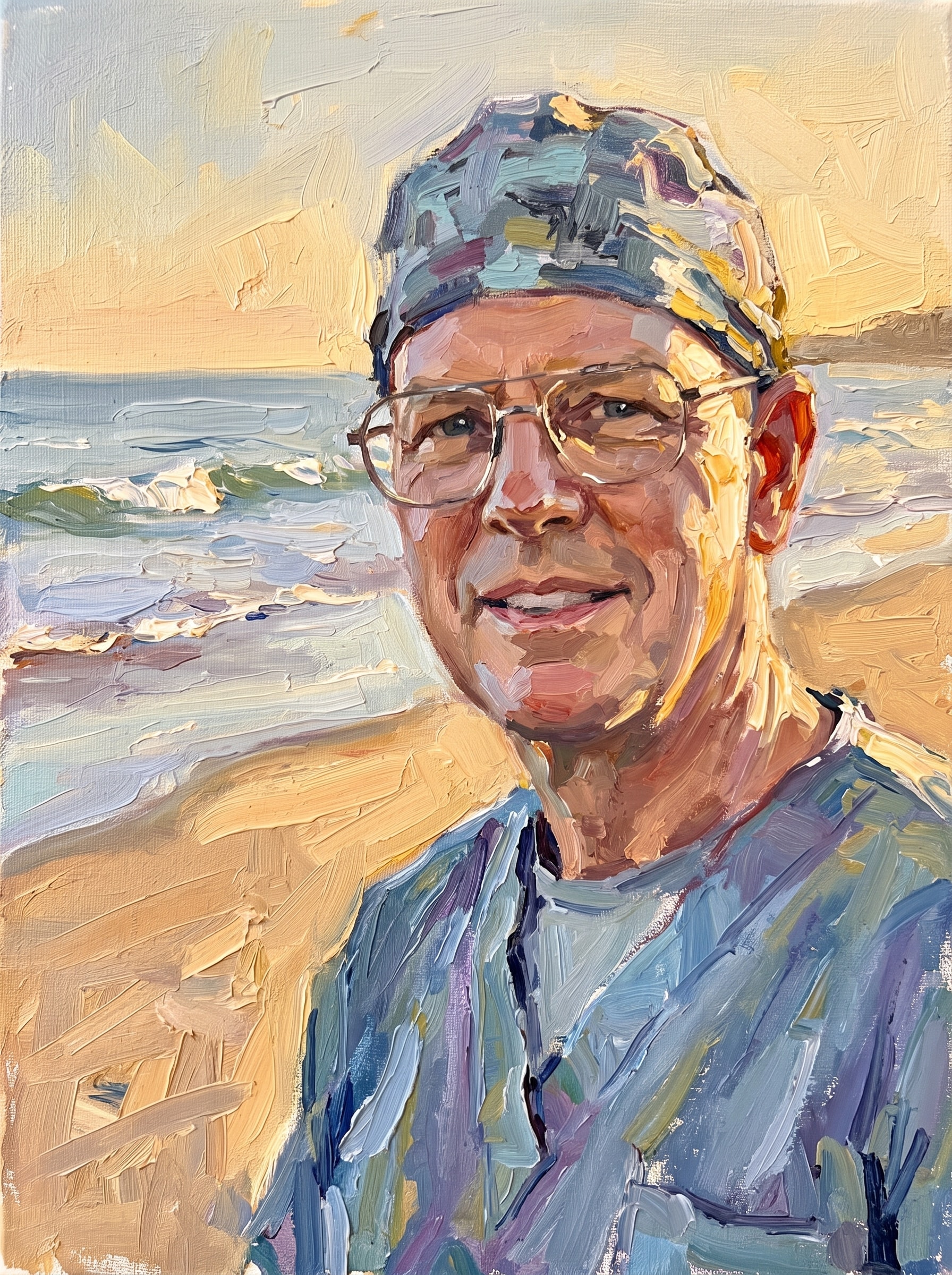
Outside the operating room, Dr. Bednar is an accomplished plein-air painter with prior gallery representation along the West Coast — a dimension that has never been separate from his surgical practice.
For fat cell viability.
Fat transfer to breast is one of the technically narrower procedures in aesthetic surgery — the margin between an excellent long-term outcome and a disappointing one comes down to specific choices at each of three stages: how the fat is harvested, how it is processed, and how it is placed. Dr. Bednar's approach is built around four principles refined over decades of practice.
Low-vacuum liposuction.
Traditional liposuction can apply extreme shear stress, tearing adipocyte cell membranes and reducing cell survival before the transfer ever happens. Dr. Bednar uses a gentle, low-vacuum suction technique with specific IV fluid formulas designed to safely 'float' cells out of the donor site without irreparably harming them.
Controlled centrifugation.
Processing fat to remove impurities is essential, but high-speed centrifugation destroys cell walls. He spins the mixture at a carefully modified rate that removes the bulk of the fluid but deliberately leaves roughly 20% to 30% of the fluid medium behind. This preserves cell structure and keeps the cells in a fluid state so they distribute smoothly during reinjection.
Microdroplet injection · multi-layering.
For fat to survive permanently it must develop a new blood supply from the surrounding tissue. By injecting the purified fat in tiny microdroplets across multiple tissue layers, each cell gets maximum surface-area contact with existing healthy tissue — promoting rapid vascularization and dramatically lowering the risks of fat necrosis or oil cysts.
Advanced synergistic protocols.
Where clinically indicated, Dr. Bednar's practice references studies and protocols involving Cell-Assisted Lipotransfer (CAL) and Platelet-Rich Plasma (PRP). The clinical evidence suggests combining these elements can enhance vascular growth factor levels, reduce cell death, and improve overall graft retention by 35% to 40% compared with traditional grafting techniques.
Expected biological retention: In the broader medical literature that aligns with Dr. Bednar's clinical practice, the human body typically reabsorbs between 20% and 50% of transferred fat within the first 3 to 6 months. The remaining percentage of integrated cells develops a permanent blood supply and stays indefinitely. This is why realistic expectations, staged sessions in some cases, and the technique refinements above all matter.
Does not perform implant exchanges.
"Dr. Bednar is one of a small number of surgeons in the country who have made fat transfer to breast their signature technique. His artistic sensibility is inseparable from his surgical judgment."
The Foundation.
Wayne State University School of Medicine · Detroit
Michigan State College of Medicine at Butterworth Hospital · Grand Rapids
Memorial Hospital · Miami, Florida · 1986–1988
American Board of Plastic Surgery
Bednar Cosmetic Surgery · Charlotte, North Carolina · founded 2009
Fat Transfer to Breast (exclusive) · Does not perform implant exchanges
Plein-air painter with prior West Coast gallery representation
Dr. Bednar's primary practice is in Charlotte, North Carolina. For fat-transfer-to-breast consultations at NCSS in Newport Beach, coordinate through the NCSS clinical team.
(949) 644-8182
Our clinical team will coordinate your fat-transfer-to-breast consultation and NCSS surgical scheduling with Dr. Bednar.
Bednar Cosmetic Surgery · Charlotte, NC · Dr. Bednar's home practice